
Multi‑ Layering Technology in Nonwoven Fabrics

Share Post
Nonwoven bags have become a global staple not only because they are reusable and more sustainable than single‑ use plastics, but because they represent the convergence of material science, manufacturing ingenuity, and consumer demand for durability and performance. At the heart of this convergence is composite manufacturing technology: the art and science of combining distinct layers of materials to produce a product that is stronger, more functional, and more versatile than the sum of its parts.
To appreciate why composite and multi‑layer nonwoven bags are superior, one must first understand what is meant by these terms. Nonwoven fabrics, unlike woven or knitted textiles, are made by bonding or interlocking fibers through mechanical, thermal, or chemical means. These fabrics are not only lightweight and cost‑effective, but their properties can be tailored for strength, texture, and breathing capabilities.
 A composite material, in this context, refers to a fabric system where different materials or layers are bonded together to achieve a desired combination of properties such as high tensile strength, water resistance, tear resistance, and aesthetic appeal. When these layers are stacked purposefully and engineered precisely, it becomes a multi‑layer nonwoven structure.
These advanced structures are no longer mere bags but are complex assemblies where each layer contributes unique functionality. For example, one layer might provide mechanical strength, another might enhance print quality for branding, while yet another might provide moisture resistance. The synergy of these layers results in superior performance compared to traditional single‑ layer nonwoven bags.
In essence, composite and multi‑layer nonwoven bags reflect how material science has matured from making a fabric that simply holds things, to engineering systems that can withstand repeated usage, varying loads, environmental stress, and visual demands.
To visualize the remarkable advantages of multi‑layer nonwoven bags, consider the following table that contrasts typical layers used and the properties they contribute:
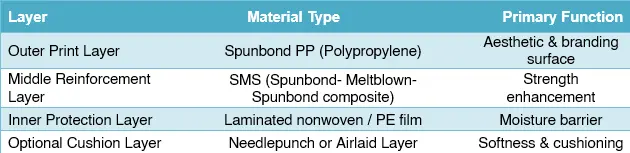
 This layering concept enables manufacturers to build bags that are not just carriers, but engineered tools. The strategic combination of spunbond and meltblown fabrics, sometimes even with laminated films, allows for enhanced mechanical properties, moisture control, and design flexibility. Composite technology is not merely layering for thickness each layer is selected based on what it brings to the final performance.
The future of composite nonwovens lies in even more sophisticated combinations, such as incorporating biodegradable polymers, antimicrobial agents, or smart fibers that respond to environmental stimuli.
While consumers see only the end product, the underlying processes that transform raw fibers into robust composite nonwoven bags are a blend of engineering, precision, and continuous quality optimization.
At the outset, the journey starts with fiber selection. Polypropylene (PP) remains a dominant choice because of its versatility, cost‑effectiveness and compatibility with bonding technologies. However, composite manufacturing invites a diversity of materials: polyethylene (PE), polyester (PET), and even renewable biopolymers are integrated in selected layers to tailor function.
The production of nonwoven fabrics that form these layers primarily involves technologies such as spunbonding and meltblowing. Both processes create webs of fibers that are later bonded. Spunbonding yields relatively strong and coarse fabrics, while meltblown processes produce much finer microfiber webs with excellent barrier and filtering properties.
What elevates composite technology is the integration of these fabrics. A classic example is the SMS nonwoven, which stands for Spunbond‑Meltblown‑Spunbond. This composite structure merges layers produced in the same production line, bonding them thermally or mechanically in a continuous sequence. Such integration ensures that the layers function as one cohesive material during bag forming and use.
Once the nonwoven rolls are ready, they proceed to bag forming machinery. Here, an example of a widely respected machine is the Ultrasonic Nonwoven Bag Making Machine model UB‑5000, manufactured by Reifenhäuser Reicofil GmbH & Co. KG, a German company renowned for high‑precision nonwoven production lines. This equipment uses advanced ultrasonic bonding to join layers and shape bags without the need for stitching or adhesives. The result is a clean, strong weld that enhances bag aesthetics and structural integrity.
 The conversion of composite nonwoven rolls into consumer-ready bags is a well-coordinated, precision-driven process. Large rolls are first unwound and cut into exact sizes, after which the material is folded and pleated to create different bag structures such as flat, gusseted, or bottom-sealed designs. The cut pieces are then bonded and sealed using heat or ultrasonic technology, with ultrasonic bonding offering stronger seams while eliminating the need for stitching, thereby improving recyclability. Handles are integrated seamlessly, either formed from the same composite fabric or added as straps, without damaging the bag body. Finally, each batch passes through automated quality checks for strength, dimensions, and print clarity before being packed. This process is continuously optimized by adjusting fiber properties, bonding parameters, and line speed to meet evolving performance and market requirements.
UB‑5000 Ultrasonic Nonwoven Bag Making Machine (Reifenhäuser Reicofil GmbH & Co. KG)

A compelling reason why composite nonwoven bags command such market enthusiasm is sustainability. Traditional single‑use plastic bags have created global environmental crises. Composite multi‑layer nonwoven bags have emerged as a viable alternative, not only because they are reusable but because recent technological advances have made them recyclable and more eco‑responsible.
B500 Fully Automatic Non-Woven Bag Making Machine (Oyang)
When composite layers are comprised of like materials e.g., all polypropylene end‑of‑life recycling becomes feasible. Contrast this with composite systems that mix polymers with incompatible recycling streams (like PE laminated to PET), which complicates recycling. As a result, modern composite manufacturing increasingly prioritizes mono‑material composites where possible structures that deliver performance while simplifying recycling.
 Additionally, research into biodegradable and bio‑based polymers is accelerating. In some cases, composite nonwovens now incorporate polylactic acid (PLA) layers or other biopolymers. Though cost and performance challenges still exist, the industry is moving toward composites that are both high‑performance and biodegradable under industrial composting conditions.
Composite technology also opens doors to functional enhancements. Consider a bag used for food packaging: the inner layer can be engineered with moisture barriers; the outer layer can be optimized for UV printing for branding; while an intermediate electrostatic dissipative layer could be added for sensitive products. This functional layering sets composite nonwovens apart from any conventional material.
The Role of Composite Manufacturing in Market Evolution
The global shift toward composite nonwoven bags reflects not just material science but changing consumer values and regulatory pressures. Governments around the world are implementing bans and levies on single‑use plastic bags, compelling retailers and manufacturers to adopt reusable alternatives. Consumers increasingly prefer products that balance durability, sustainability, and design.
Composite/multi‑layer nonwoven bags fit this paradigm perfectly. Their enhanced strength ensures repeated reuse; their structural integrity maintains brand visibility; and their engineered properties can be tuned for specific end‑uses (e.g., food, textiles, electronics).
This confluence of demand and capability has spurred rapid adoption across sectors:
- Retail & Supermarkets: Replace plastic bags with branded composite nonwoven bags that carry higher load capacities.
- Fashion & Lifestyle: Use composite nonwovens with premium printing and texture enhancements to elevate perceived value.
- Agriculture & Horticulture: Multi‑layer bags offer breathability for roots and superior moisture management.
- Industrial Logistics: Customized composite nonwoven bags support heavier loads with abrasion resistance.
Composite technology has also enabled nonwoven bags to enter specialized markets once dominated by textiles or plastics. For instance, composite bags with barrier layers are now used in medical and pharmaceutical packaging, where moisture control and sterility are critical.
Comparative Insights: Standard vs Composite Nonwoven Bags
To better appreciate the tangible benefits of composite manufacturing technology, the following comparison highlights key performance differences
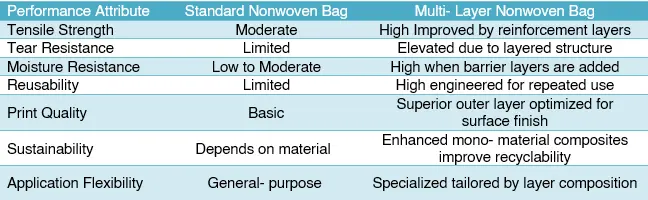
This comparison underscores how composite technology transforms nonwoven bags from utility items into engineered solutions. Where a standard nonwoven bag might fail under heavier load or repeated use, a composite counterpart maintains performance due to its integrated design.
Despite their advantages, composite nonwoven bags face challenges that spur continued innovation. One challenge is balancing performance with cost. Multi‑layer constructions inherently involve more materials and more complex production lines, which can increase unit cost. However, economies of scale and ongoing material innovation are narrowing this gap.
Another challenge lies in end‑of‑life management. While mono‑material composites improve recyclability, not all composite bags are currently recycled at scale due to infrastructure limitations. This means that industry, governments, and recycling stakeholders need to forge collaborations for effective waste management systems.
The opportunities, however, are vast. Composite technology is advancing beyond simple layering to include functional additives, smart textiles, renewable fibers, and nanotechnology enhancements. Imagine a nonwoven bag that monitors its own load stress, or one that degrades harmlessly in the environment after a programmed lifecycle.
What makes composite nonwoven bags truly fascinating isn’t just the technology itself, but the broader human and environmental narrative. Around the world, communities plagued by plastic pollution are embracing alternatives that reduce waste, promote reuse, and align with circular economy principles. Composite nonwoven bags represent a bridge between performance and sustainability proving that engineered solutions can be ecologically responsible without compromising utility.
From a social standpoint, the rise of composite nonwoven bag manufacturing has stimulated economic activity from raw material suppliers to machine manufacturers like Reifenhäuser Reicofil to local bag producers who serve regional markets. These supply chains create jobs, foster technical expertise, and enable small businesses to offer customized, branded products to their communities.
As we look toward the future, composite and multi‑layer manufacturing technology in nonwoven bags will continue evolving in tandem with materials science, consumer expectations, and global sustainability goals. Innovations such as biopolymer composites, advanced barrier layers, smart sensors integrated into textiles, and closed‑ loop recycling systems are on the horizon.
What remains certain is that nonwoven bags, once simple solutions to single‑use plastic problems, have transformed into sophisticated manufactured systems. They are a testament to how thoughtful engineering rooted in composite and multi‑layer technologies can produce products that not only fulfill functional needs but also resonate with ecological responsibility and design elegance.
In this ongoing narrative, every layer tells a story: of Fibers engineered for strength, of material science advancing performance, of manufacturing technologies like the Reifenhäuser Reicofil ultrasonic bonding systems enabling precision and quality, and of human choices shaping sustainable futures. These layers, collectively, elevate nonwoven bags from everyday objects to symbols of innovation and sustainability.
01:19 PM, Feb 12

.webp)
.webp)




1.jpg)
1.jpg)


